Basement Wall Crack Repair in Glen Mills, PA
DMR Waterproofing provides foundation and basement wall crack repair for homeowners throughout Glen Mills, PA. Glen Mills is an unusual market because its housing stock splits into two very different categories, and each one cracks for entirely different reasons.
On one side are the antique stone farmhouses and older homes scattered across Thornbury and Concord Townships — properties with fieldstone foundations, deteriorating mortar joints, and no exterior waterproofing whatsoever. On the other are the extensive subdivisions and communities built from the 1990s onward, sitting on poured concrete foundations that develop shrinkage and settlement cracking within their first decade. Homeowners in newer construction are frequently surprised to find a crack at all, assuming a recent build shouldn’t have one. In practice, poured foundations almost always develop some cracking as concrete cures and as backfilled soil settles around the footing.
We repair both, but we do not approach them the same way. The evaluation always comes before the recommendation.

Why Glen Mills Foundations Crack
Backfill settlement around newer construction. When a foundation is built, the soil excavated for it is pushed back against the wall afterward. That backfill stays looser and more permeable than undisturbed ground for years, which means it holds more water and settles unevenly. This is the single most common source of cracking in Glen Mills’ newer subdivisions, and it typically shows up in the first five to ten years.
Concrete shrinkage. Poured concrete gives up moisture as it cures and shrinks slightly in the process. Thin vertical hairline cracks are the routine result. They are rarely structural, but they leak, and they widen over time with freeze-thaw exposure.
Deteriorated mortar in historic stone foundations. Older Glen Mills properties with stone and rubble foundations lose mortar integrity gradually. Water finds those joints long before any structural issue develops.
Piedmont soils and seasonal moisture swings. The clay-bearing residual soils across this part of Delaware and Chester County expand when saturated and contract when dry, applying cyclical lateral pressure against foundation walls.
Sloped and graded lots. Many Glen Mills developments were built on graded terrain. Where a home sits below the grade of surrounding land, the uphill foundation wall carries substantially more soil and water pressure than the others — and that’s typically where horizontal cracking or bowing shows up first.
Freeze-thaw. Water in an existing crack expands as it freezes, widening the crack incrementally each winter. DMR also handles winter basement wall crack repairs for cracks that surface mid-season.
Reading the Crack: What Different Patterns Mean
Hairline and shrinkage cracks — thin vertical cracks in poured walls, common in newer Glen Mills homes. Not typically structural, but they admit water and should be sealed.
Vertical cracks — usually settlement or hydrostatic pressure. Repairable by injection in most cases.
Diagonal cracks — indicate uneven settlement between sections of the foundation. Worth evaluating, particularly on graded lots.
Stair-step cracks — follow mortar joints in stone or block walls. Signal differential settlement or lateral pressure and should always be professionally assessed.
Horizontal cracks — the most serious. External soil pressure pushing inward, often paired with visible wall bowing. Requires structural evaluation before any sealing work.
Our Basement Wall Crack Repair Process
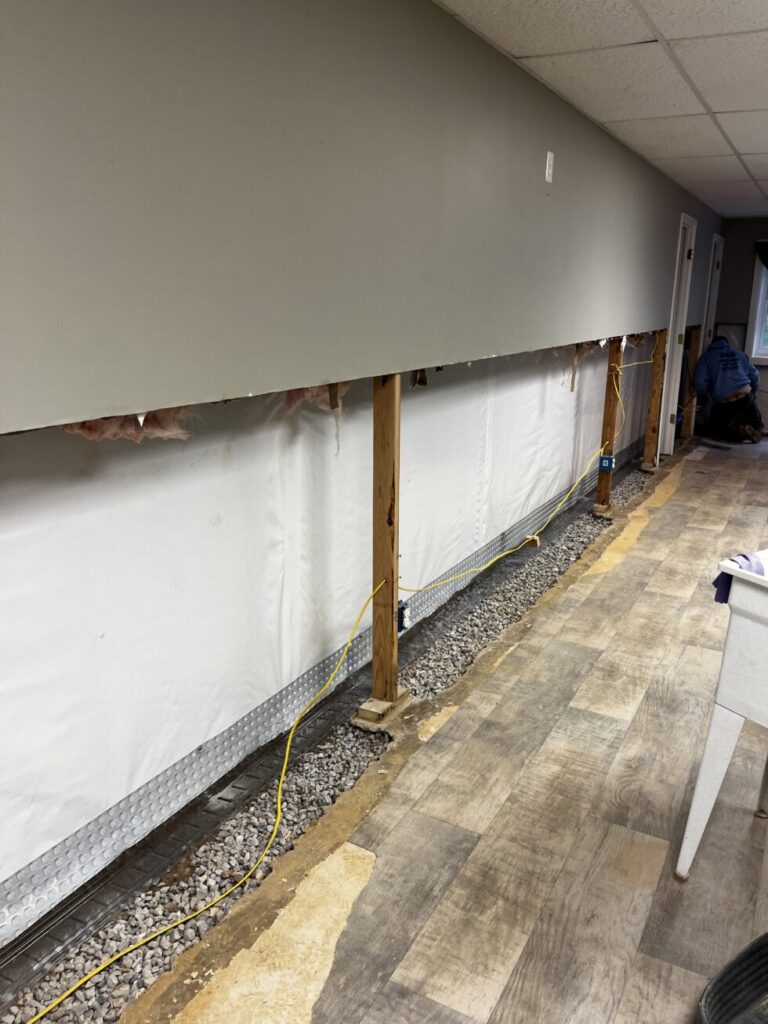
- Inspection and diagnosis. We determine crack type, measure width and length, check for evidence of ongoing movement, and identify the underlying cause. We also look for other water entry points, since cracks are often one symptom among several.
- Surface preparation. The crack and surrounding area are cleaned and prepped so repair material bonds to sound concrete.
- Injection port placement. Ports are installed along the full length of the crack so material penetrates the entire wall thickness rather than bridging the surface only.
- Epoxy or polyurethane injection. Epoxy restores structural strength in poured concrete and is our standard for stable structural cracks. Polyurethane expands and stays flexible, making it the better option for actively leaking cracks and walls with minor ongoing movement.
- Structural reinforcement when needed. Bowing walls or horizontal cracking may call for carbon fiber straps or additional reinforcement rather than sealing alone.
- Integration with waterproofing. Repairs are coordinated with the property’s overall water management plan.
Complete Basement Protection in Glen Mills
Crack repair stops water at a specific point. It doesn’t relieve the pressure that created the crack. Where cracks keep recurring or water finds new entry points, the underlying condition needs to be addressed — often through sump pump installation and interior drainage, exterior yard drainage to correct grading and roof runoff, or comprehensive basement waterproofing solutions. For homes with persistent dampness and humidity, basement and crawlspace encapsulation is often the missing piece.
DMR serves Glen Mills and surrounding Delaware and Chester County communities. See related crack repair work in West Goshen, or our sump pump services in Chadds Ford and Newtown Square.
Frequently Asked Questions
My house is only eight years old. Why does it have a foundation crack? This is one of the most common questions we get in Glen Mills. Poured concrete shrinks as it cures, and backfilled soil around a newer foundation settles unevenly for years. Cracks in newer homes are normal — they still need sealing, because they leak.
Does a crack in a new home mean the builder did something wrong? Usually not. Shrinkage and settlement cracking are expected outcomes of normal construction. That said, if your home is still under a structural warranty, it’s worth checking your coverage before scheduling work.
Can you repair cracks in an old stone farmhouse foundation? Yes. Stone foundations fail differently — typically across deteriorated mortar joints rather than at a single crack — so the solution often combines repointing, injection where appropriate, and interior drainage.
How much does crack repair cost in Glen Mills, PA? It depends on crack count, length, wall material, and whether structural reinforcement is required. All estimates are free and provided upfront.
How long does the repair take? Most single-crack injection repairs are completed in a few hours. Multiple cracks or added structural reinforcement extend the timeline, and we’ll give you a realistic estimate before starting.