Basement Wall Crack Repair in Devon, PA
Basement Wall Crack Repair Services in Devon, PA
DMR Waterproofing repairs leaking and structural foundation cracks for homeowners throughout Devon, PA. Devon presents a particular set of conditions that we see repeatedly on this stretch of the Main Line. Much of the housing stock here dates to the early and mid twentieth century, and a substantial share of it sits on fieldstone or early block foundations built well before modern waterproofing membranes or drainage practices existed. Those walls do not crack the way a modern poured foundation does. They fail along mortar joints, in stair-step patterns through block, and at the transitions where a later addition was joined to original construction.
Our team is trained to read what a crack is telling you before recommending a repair. A hairline shrinkage crack in a poured wall and a widening stair-step crack in a stone foundation are entirely different problems, and sealing one the way you’d seal the other wastes money and leaves the actual issue unaddressed. We diagnose the cause first — soil pressure, settlement, water intrusion, or thermal movement — then match the repair method to it.

Why Devon, PA Foundations Develop Cracks
Older stone and block construction. Devon’s established neighborhoods are full of stone colonials and homes built before mid-century. Mortar in fieldstone walls deteriorates over decades, opening pathways for water long before any structural concern exists. Block foundations from the 1950s through 1970s are porous and crack along the joint lines under lateral soil pressure.
Clay-heavy Piedmont soils. The residual soils across this part of Chester County hold moisture and expand and contract seasonally. That cycle applies steady pressure against foundation walls and is one of the most common drivers of vertical and diagonal cracking in the area.
Mature tree canopy. Devon’s large, established trees are a real asset and a real factor in foundation movement. Root systems draw significant moisture from the soil during dry stretches, causing localized shrinkage and differential settlement near the foundation. When heavy rain returns, that soil swells again. The repeated cycle is hard on a foundation wall.
Freeze-thaw cycling. Every winter, water sitting inside an existing hairline crack freezes and expands, widening the crack incrementally. A crack that leaked slightly last spring often leaks noticeably by the next one. This is why we recommend addressing cracks before winter rather than after — and why DMR offers winter basement wall crack repairs for homeowners who discover the problem mid-season.
Additions and renovations. Devon has a lot of expanded and renovated homes. Where a newer addition meets an older foundation, the two sections settle at different rates, and cracking at that seam is common.
Types of Basement Wall Cracks and What They Indicate
Hairline and shrinkage cracks. Thin, narrow cracks in poured concrete, typically appearing within the first few years as concrete cures. Usually not structural, but they still admit water and should be sealed.
Vertical cracks. Often the result of normal settlement or hydrostatic pressure. Generally repairable by injection, though a vertical crack that widens over time warrants closer evaluation.
Diagonal cracks. Typically indicate uneven settlement — one section of the foundation moving relative to another. Common in Devon homes with additions or on sloped lots.
Stair-step cracks. Follow the mortar joints in block or stone walls in a stepped pattern. These signal differential settlement or lateral soil pressure and should always be assessed by a professional.
Horizontal cracks. The most serious category. A horizontal crack usually means external soil pressure is pushing against the wall, and it can be accompanied by bowing or inward movement. These require structural evaluation, not just sealing.
If you’re unsure which you’re looking at, that’s exactly what the free evaluation is for. We would rather tell you a crack is cosmetic than have you ignore one that isn’t.
Our Basement Wall Crack Repair Process
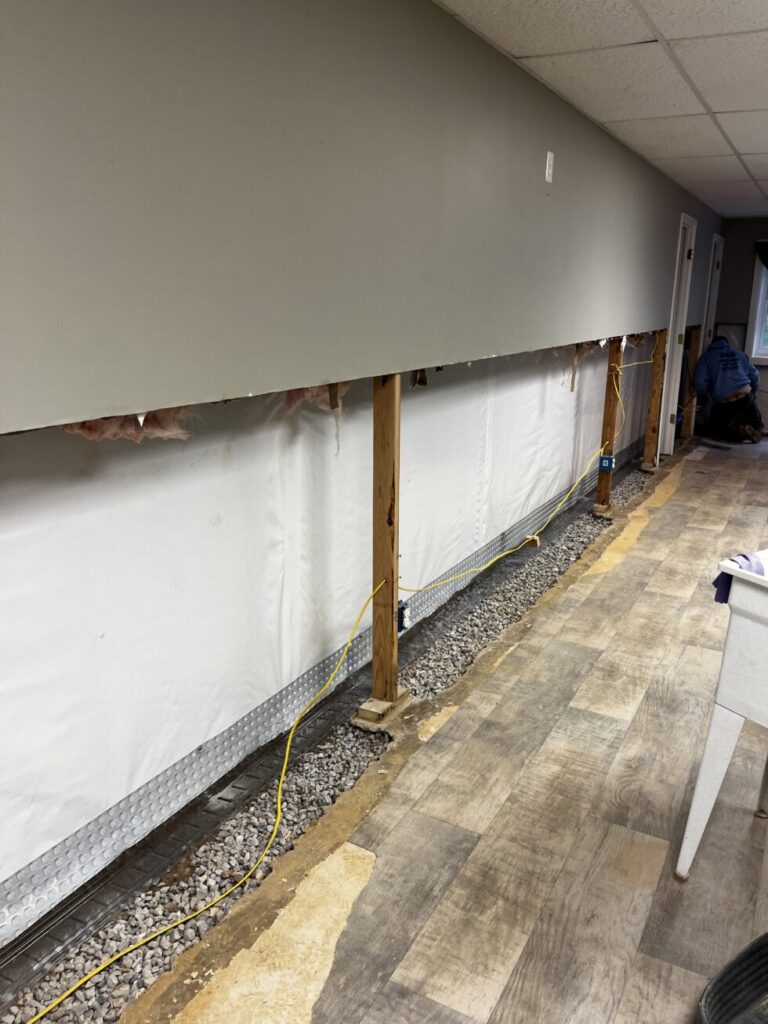
- Inspection and diagnosis. We identify the crack type, measure its width and length, look for signs of active movement, and determine the underlying cause. We also check for water entry points elsewhere in the basement, since a single crack is rarely the whole story.
- Surface preparation. The crack and surrounding wall are cleaned and prepped so the repair material bonds properly to sound substrate.
- Injection port placement. Ports are set along the full length of the crack at appropriate intervals so material reaches the entire depth of the wall, not just the visible surface.
- Epoxy or polyurethane injection. Structural cracks in poured concrete are typically repaired with epoxy, which restores the wall’s strength. Actively leaking cracks are often better served by polyurethane, which expands to fill irregular voids and remains flexible. We select based on the crack, not on convenience.
- Structural reinforcement when warranted. Where a wall shows bowing or a horizontal crack indicates ongoing soil pressure, carbon fiber straps or additional reinforcement may be recommended.
- Waterproofing integration. Crack repair is coordinated with the rest of the basement’s water management so you aren’t sealing one entry point while water simply finds another.
When Crack Repair Isn’t Enough On Its Own
Sealing a crack stops water at that specific point. It does not lower the water table, correct a negative grade, or relieve hydrostatic pressure against the wall. If cracks keep appearing, or if water continues finding new entry points after a repair, the underlying condition needs attention. Depending on the property, that may mean sump pump installation and interior drainage, exterior yard drainage to move surface water and downspout discharge away from the foundation, or full basement waterproofing solutions. For persistently damp lower levels, basement and crawlspace encapsulation addresses the humidity that crack repair alone won’t touch.
DMR Waterproofing serves Devon and the surrounding Main Line communities. See our related work in Exton and West Goshen, or learn about sump pump installations in Devon, Berwyn, and Wayne.
Frequently Asked Questions
How do I know if a basement wall crack is serious? Width, direction, and change over time are the key indicators. Horizontal cracks and any crack accompanied by wall bowing are the most concerning. A crack that has visibly widened, or one leaking water under normal rainfall, should be evaluated regardless of type.
Can you repair cracks in a stone foundation? Yes. Stone and fieldstone foundations require a different approach than poured concrete — the failure is usually along deteriorated mortar joints across a broad area rather than a single defined crack. We assess whether repointing, injection, an interior drainage solution, or a combination is appropriate.
How much does basement wall crack repair cost in Devon, PA? It depends on the number of cracks, their length and depth, the wall material, and whether structural reinforcement is needed. Estimates are free and provided upfront with no hidden fees.
Will the repair hold permanently? A properly executed injection repair on a stable wall is a permanent seal. If the wall is still moving, the repair addresses the symptom while the cause continues — which is why diagnosis comes first.
Can cracks let in radon? Unsealed foundation cracks are a known pathway for soil gas, including radon, to enter a home. Sealing them is one component of reducing that entry, though radon mitigation itself is a separate specialty.