Coatesville, PA Basement Wall Crack Repair Services
Basement Wall Crack Repair Services in Coatesville, PA
DMR Waterproofing repairs leaking and structural foundation cracks for homeowners across Coatesville, PA. Coatesville’s housing stock and terrain combine into a specific pattern of foundation problems, and after years of working in western Chester County, we know what to look for before we walk down the basement stairs.
The city grew up around its industrial past, which left behind a dense inventory of brick rowhomes, twins, and single-family houses built largely before 1940. Those homes sit on stone and early block foundations that were never sealed from the outside. Just as importantly, Coatesville is built into the valley walls rising from the West Branch of the Brandywine, which means a significant share of properties sit on sloped ground. A foundation wall holding back an uphill grade carries far more lateral soil pressure than one on flat terrain — and that pressure is the leading cause of the horizontal cracking and wall bowing we see here.

Why Coatesville Foundations Crack
Lateral pressure from sloped lots. Homes built into a hillside have one or more foundation walls retaining soil. When that soil saturates after heavy rain, the hydrostatic pressure against the wall increases substantially. This produces horizontal cracks, inward bowing, and stair-step cracking concentrated on the uphill side — the pattern we encounter most often in Coatesville.
Aging stone and block foundations. Pre-1940 construction throughout the city relies on stone and early concrete block. Mortar joints deteriorate, block is porous, and neither was ever waterproofed on the exterior. Water moves through these walls across broad areas rather than at one identifiable point.
Brandywine valley water table. Proximity to the West Branch of the Brandywine and its tributaries keeps groundwater high in the lower sections of the city, particularly after sustained rain. Standing groundwater against a foundation drives water through every available crack and joint.
Dense lots and limited drainage room. Rowhomes and twins on narrow lots leave little space to correct exterior grade or route downspout discharge away from the foundation. Decades of settled soil have left many properties pitching water directly back toward the house.
Freeze-thaw cycling. Water inside an existing crack expands when it freezes, widening the crack incrementally every winter. For cracks discovered during the cold months, DMR offers winter basement wall crack repairs.
Crack Types and What They Signal
Horizontal cracks deserve first mention in Coatesville, because they’re disproportionately common here. A horizontal crack means soil pressure is pushing the wall inward. It is a structural indicator, not a cosmetic one, and it should be evaluated promptly — particularly if you can see any bowing or inward deflection in the wall.
Stair-step cracks run through the mortar joints of block and stone walls in a stepped pattern, pointing to differential settlement or lateral pressure.
Vertical cracks typically result from settlement or hydrostatic pressure and are usually repairable by injection.
Diagonal cracks indicate uneven settlement between foundation sections, common on graded and sloped lots.
Hairline and shrinkage cracks appear in poured concrete as it cures. Not usually structural, but they still let water in.
Our Basement Wall Crack Repair Process
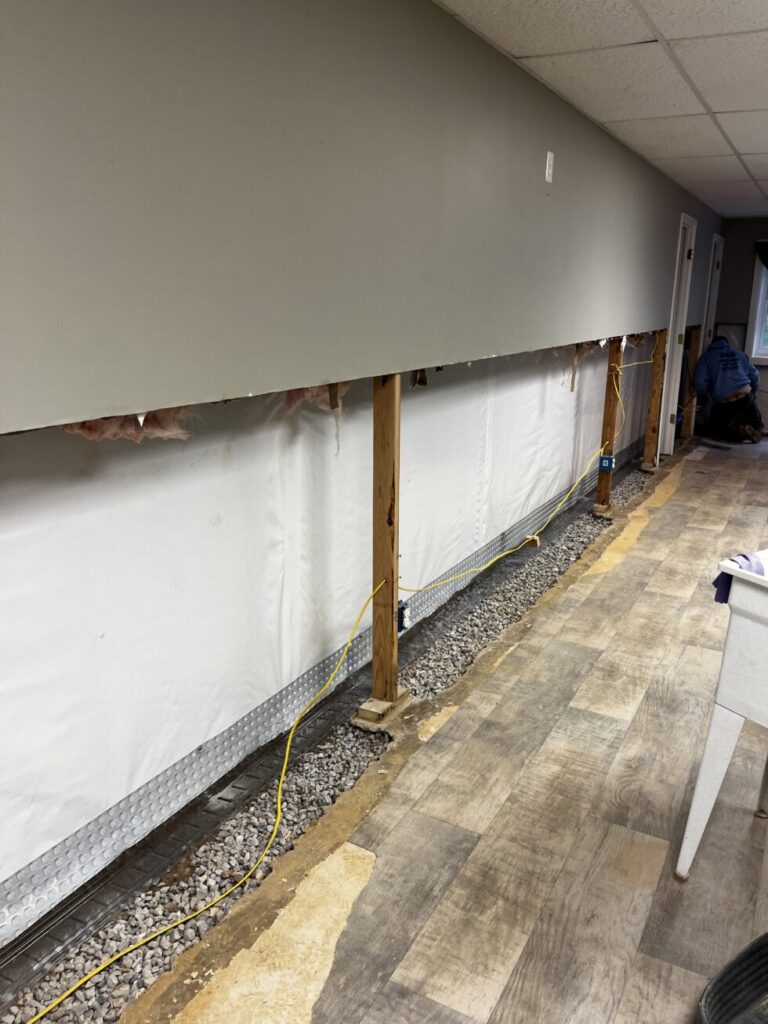
- Inspection and diagnosis. We identify crack type, measure width and length, check for wall deflection and evidence of active movement, and determine the cause. On sloped Coatesville lots, we assess the exterior grade as part of this.
- Surface preparation. The crack and surrounding wall are cleaned and prepped for proper adhesion.
- Injection port placement. Ports are set along the crack’s full length so material fills the entire wall depth, not just the face.
- Epoxy or polyurethane injection. Epoxy restores structural strength in stable poured-concrete cracks. Polyurethane expands into irregular voids and remains flexible, making it appropriate for actively leaking cracks.
- Structural reinforcement. Where horizontal cracking or bowing indicates ongoing soil pressure, carbon fiber straps or additional reinforcement are recommended. Sealing a bowing wall without addressing the pressure behind it is not a repair.
- Waterproofing integration. Crack work is coordinated with the property’s overall drainage and water management.
Addressing the Cause, Not Just the Crack
In Coatesville more than most markets, crack repair alone is frequently insufficient. If lateral soil pressure or a high water table created the crack, sealing it does not remove that pressure. A durable outcome usually pairs the repair with pressure relief — sump pump installation and interior perimeter drainage to lower the water load against the wall, plus exterior yard drainage to move surface water and roof runoff away from the foundation. For a comprehensive approach, see our basement waterproofing solutions and basement and crawlspace encapsulation services.
We’ll tell you honestly which category your situation falls into. If a single crack in an otherwise stable wall is the whole problem, that’s what we’ll quote.
DMR Waterproofing serves Coatesville and western Chester County. See our crack repair work in Exton and West Goshen, or sump pump services in Thorndale, Downingtown, and Glenmoore.
Frequently Asked Questions
I have a horizontal crack in my basement wall. How urgent is it? Horizontal cracks are the category we treat most seriously. They indicate soil pressure pushing against the wall, and they can progress to bowing and structural failure if left alone. Schedule an evaluation rather than waiting to see whether it worsens.
What is wall bowing, and can it be fixed? Bowing is inward deflection of a foundation wall under sustained soil pressure. Depending on severity, it can often be stabilized with carbon fiber reinforcement combined with drainage improvements that reduce the pressure. Advanced cases require more extensive intervention, which we’ll assess honestly.
My house is on a hill. Does that make cracking more likely? It makes lateral pressure on the uphill wall more likely, yes. That’s a common Coatesville condition, and it’s why we evaluate exterior grade alongside the interior wall.
Can you repair cracks in an old stone or block foundation? Yes. These walls typically leak across deteriorated mortar joints rather than at one clean crack, so the solution often combines repointing, targeted injection, and interior drainage.
How much does basement wall crack repair cost in Coatesville, PA? Cost varies with crack count, length, wall type, and whether structural reinforcement is needed. All estimates are free, provided upfront, and carry no hidden fees.